
New technical resource demonstrates how a single enhanced linear regulator achieves high efficiency across USB and battery input voltages — without switching noise
Alexandria, VA – March 2, 2026 – Polaris Semiconductor LLC today published PSAN004, a new application note detailing an adaptive dual-mode regulation technique that enables a single enhanced linear regulator (ELR) to efficiently serve systems powered by both USB and Li-Ion battery sources while maintaining the noise performance of a conventional linear regulator.
The application note addresses a well-known design challenge in portable precision electronics: maintaining low-noise, high-efficiency power delivery when the input voltage can range from 3.5 V (discharged Li-Ion cell) to 5.5 V (USB). Conventional approaches require designers to choose between a simple linear regulator — which operates efficiently from battery but dissipates excessive heat from USB — and switching architectures that improve efficiency at the cost of added complexity, board area, and switching noise.
The technique demonstrated in PSAN004 uses the Polaris Semiconductor BK301D33L, which co-packages proprietary GaAs photovoltaic-output optocouplers with a precision linear regulator. An external control circuit automatically selects between two operating modes based on input voltage: a conventional bypass mode for low-voltage battery operation, and an optocoupler-enhanced mode that recycles energy at higher input voltages. The transition between modes completes in under 30 microseconds.
Measured results presented in the application note include:
- 86% efficiency from a 3.7 V battery source and 73% from a 5 V USB source at 200 mA / 3.3 V output, compared to 63% for a conventional LDO at 5 V USB input
- 36% reduction in power dissipation and peak board temperature rise at 500 mA when operating in enhanced mode versus conventional LDO mode from a 5 V source
- Output noise below 1 µV RMS (10 Hz to 100 kHz) in both operating modes, with no switching-frequency content
- Adaptive circuit overhead of less than 400 µA, using a power multiplexer, micropower comparator, single MOSFET, and passive components
“Portable instruments and field-deployed analog systems shouldn’t have to compromise between clean power and efficient power,” said Dr. Matthew Lumb, CEO of Polaris Semiconductor. “This application note shows how our ELR technology resolves that tradeoff with a single-device solution that is simpler and cleaner than the architectures it replaces.”
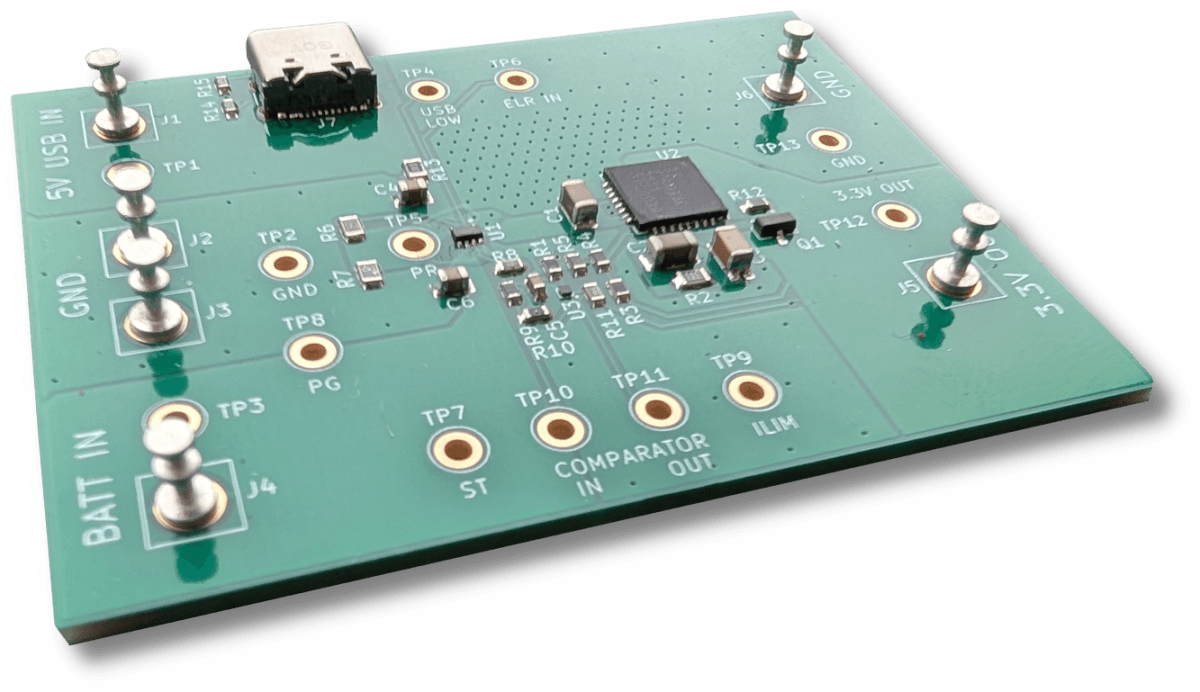
The complete application note — including schematics, PCB layout files, and bill of materials — is available for download at no cost from the Polaris Semiconductor technical documentation library. BK301D33L evaluation boards are available for purchase.
About Polaris Semiconductor
Polaris Semiconductor designs and manufactures advanced DC voltage regulators optimized for ultra-low noise, compact integration, and high efficiency across aerospace, defense, RF, precision sensing, instrumentation, and high-performance computing sectors. Based in Alexandria, VA, the company’s mission is to break through conventional limits in DC power design.
More information: www.polarissemiconductor.com