
Photovoltaic Optocouplers
Built to move power.
Up to 52% of the power into the LED comes back out as electrical power. The same optocouplers sit inside every Polaris regulator. Sample one today, or have us package several together for your design.
Where they fit
Each optocoupler pairs an LED and a photovoltaic cell on one chip, so light carries power from one circuit to another.
Enhanced Linear Regulators
Optocouplers let a linear regulator step down across large voltage drops far more efficiently, and step up or invert as well. Nothing switches, so there is no ripple to filter and no inductor to place.
Bootstrap-free gate drive
Drive a gate above or below the rail with high current, and keep a high-side switch on without a bootstrap circuit.
Floating and negative rails
Make a small rail above, below, or apart from your supply, such as a negative bias, without switching.
Supply-free signaling
Send an on/off signal to a circuit at a different voltage. The light generates the output, so the far side needs no supply.
Two parts, three regulators
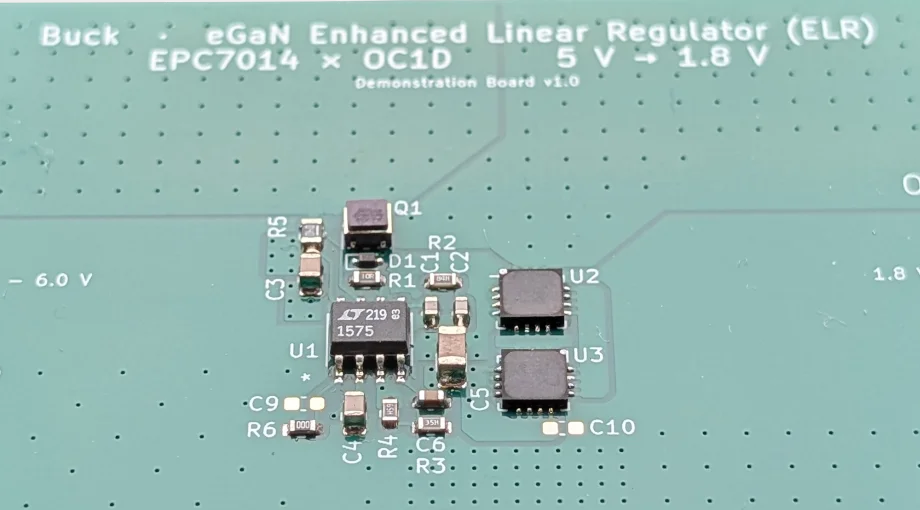
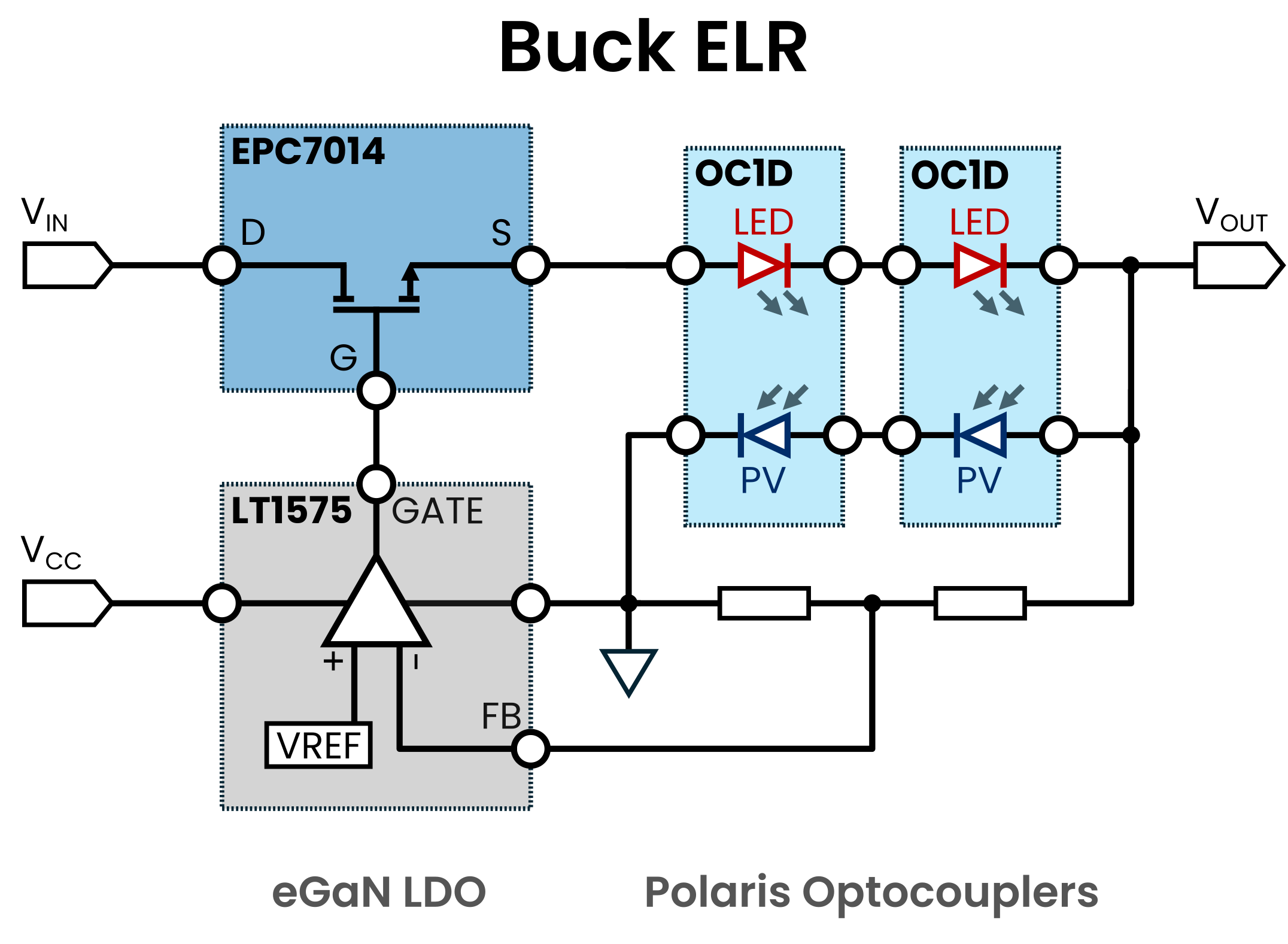
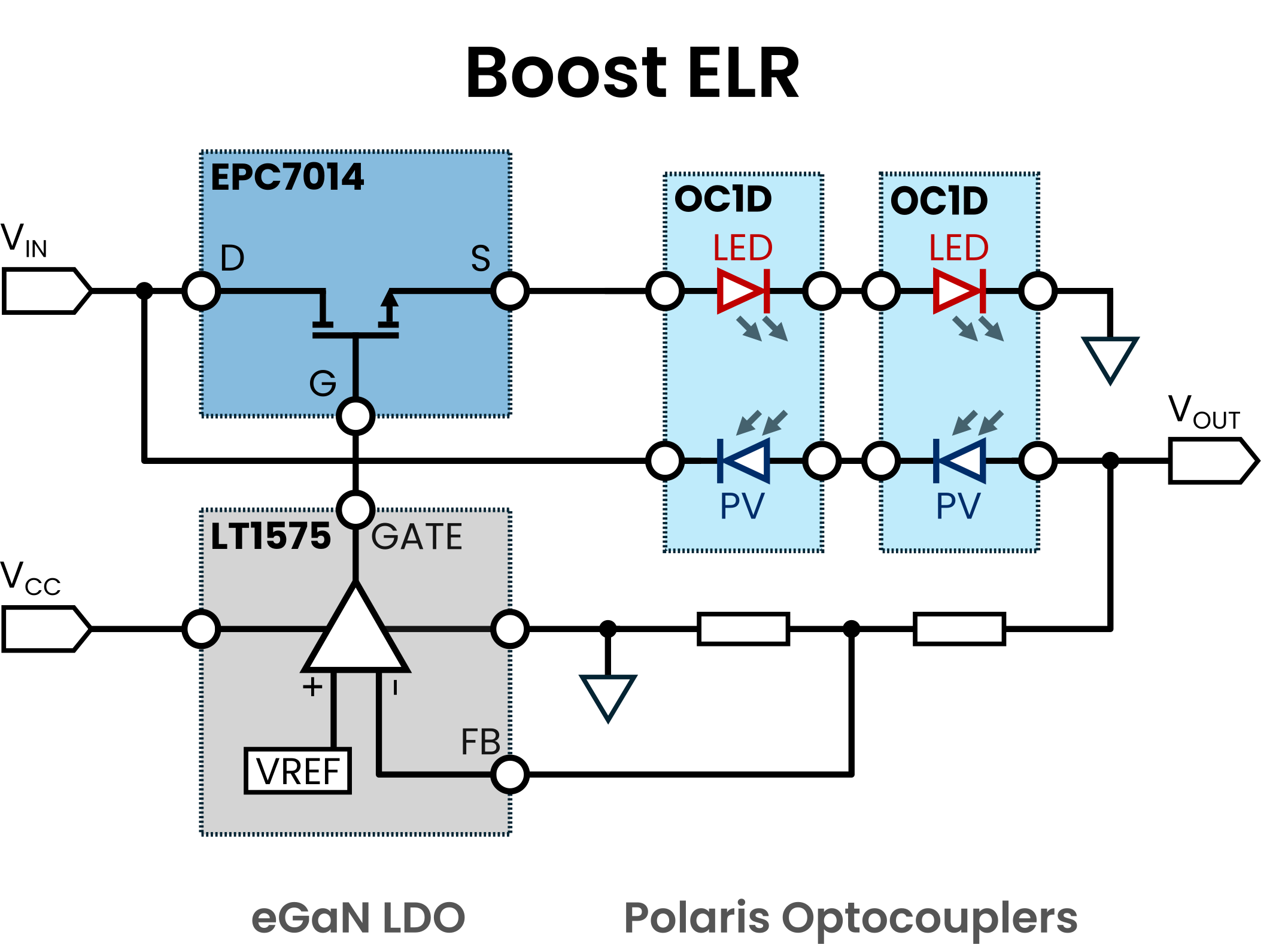
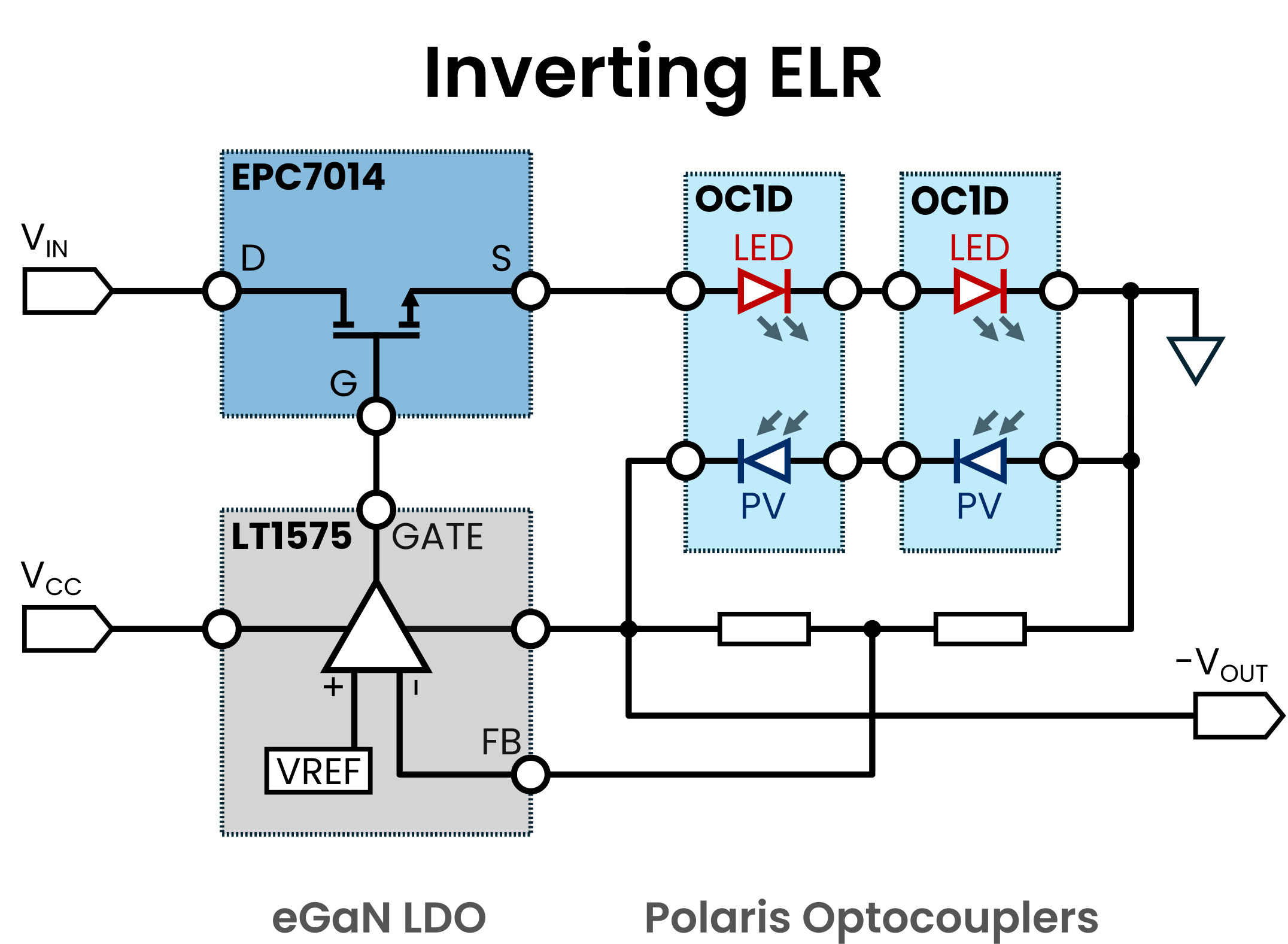
In application note PSAN006, EPC Space and Polaris built step-down, step-up, and inverting regulators on one board design. Moving between them is mostly a matter of rewiring two OC1D optocouplers.
How they work
- One chip, grown layer by layer. The LED, a blocking junction, and the photovoltaic cell are grown on top of one another, so light from the LED goes straight into the PV.
- A mirror on top. Light heading away from the photovoltaic cell is reflected back into it.
- Wired to fit. Put LEDs in series or parallel to match the supply you have, and photovoltaic cells in series or parallel for the output voltage and current you need.
- Built for harsh environments. Radiation-resilient by design, and rated from −40 to 125 °C.

One optocoupler, or several
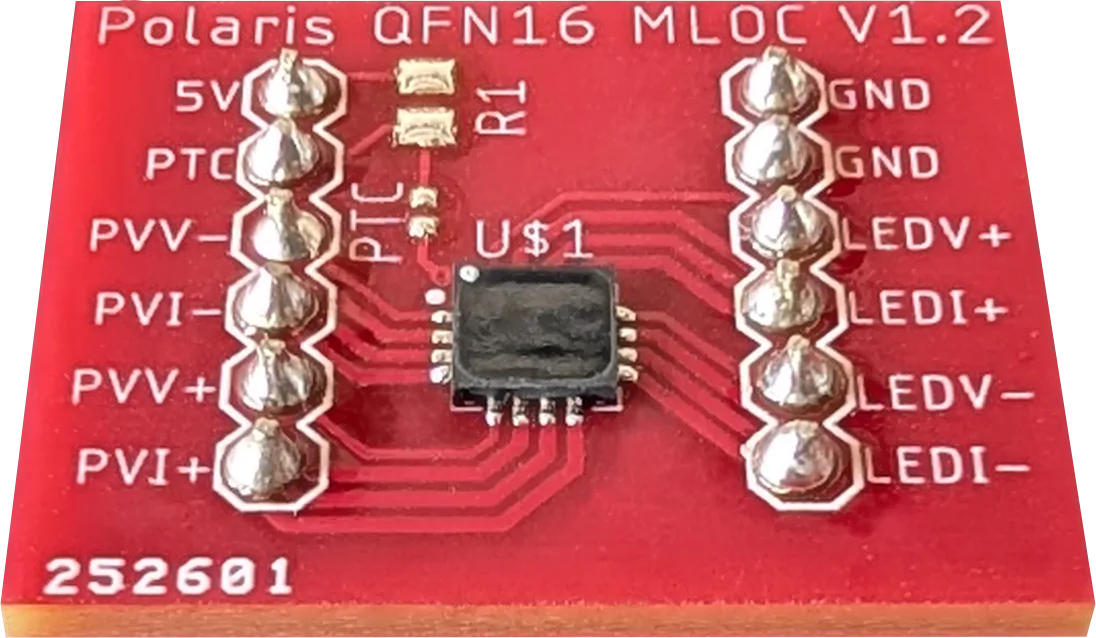
OC1D
One optocoupler (the 1 in OC1D) in a 4 × 4 mm QFN-16. Samples and evaluation boards are ready to ship.
- Device
- OC1DQ16
- LED current
- to 600 mA
- LED voltage
- 1.2–1.7 V
- PV voltage
- 1.0–1.2 V
- Efficiency
- 52% peak
- Temperature
- −40 to 125 °C
Multi-optocoupler parts
Need several optocouplers in one package, or one sized for a different current? We build them to order.
- LEDs in series or parallel to match your supply
- Photovoltaic cells in series or parallel for your load
- Junction area sized to the LED current you plan to run
Every Polaris regulator is built this way, with two to six optocouplers in one package.
Ready to design it in?
Request evaluation samples, detailed datasheets, and SPICE models — an engineer answers, not a sales funnel.