
OC1D
High-Efficiency Photovoltaic-Output Optocoupler
OC1D overview
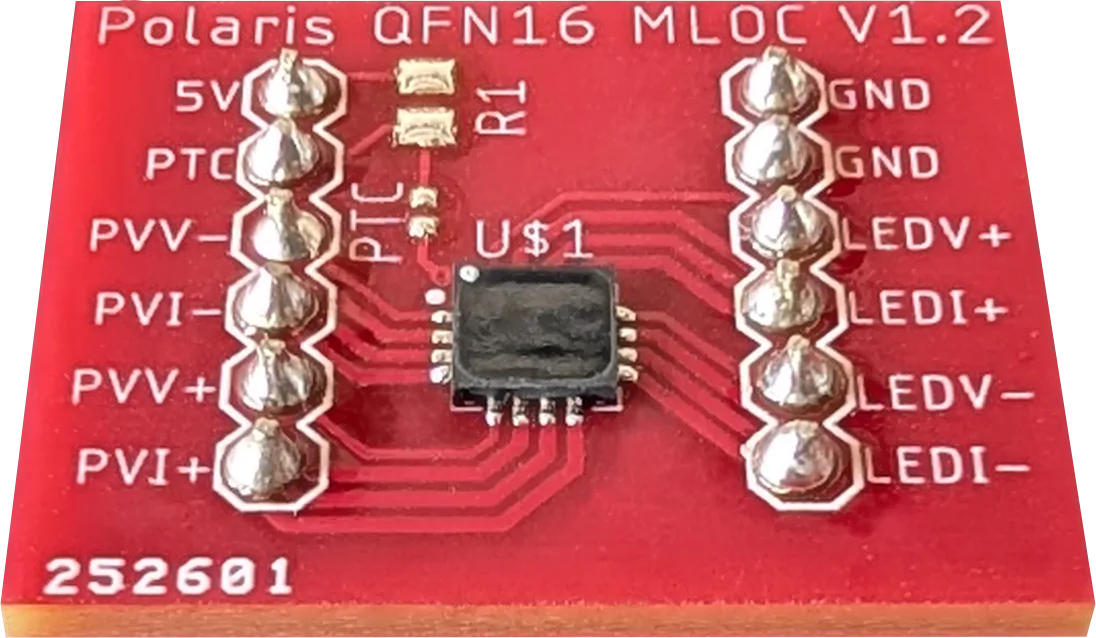
OC1D is a photovoltaic-output optocoupler built to deliver power. Polaris’ patented monolithic technology grows an LED and a photovoltaic cell as one GaAs chip, so light from the LED becomes usable current at the output. Power-transfer efficiency peaks at 52% and current transfer ratio at 73%, with LED drive up to 600 mA.
A blocking junction separates the two sides, so OC1D parts can be wired in series or parallel to build up voltage or current. That is how every Polaris Enhanced Linear Regulator works, and the same building block fits gate drivers, bias rails, and supply-free signaling.
Package: QFN-16, 4 × 4 × 0.8 mm, one optocoupler per part. Need several in one package, or a different current range? We build custom parts to order.
Device specifications
| Parameter | OC1DQ16 |
|---|---|
| Peak power-transfer efficiency | 52% |
| Peak current transfer ratio | 73% |
| LED forward voltage | 1.2–1.7 V |
| LED drive current | 0.5–600 mA |
| PV open-circuit voltage | 1.0–1.2 V |
| Small-signal CTR bandwidth (−3 dB, 48 mA DC LED bias) | 1.05 MHz |
| Isolation, LED to PV | ±21 V |
| Temperature range | −40 to 125 °C |
| Package | QFN-16 · 4×4×0.8 mm |
- Efficiency is photovoltaic output power divided by LED input power. CTR is photovoltaic short-circuit current divided by LED current.
Applications
- Enhanced Linear Regulators
- Bootstrap-free high-side gate drive
- Floating and negative bias rails
- Supply-free signaling
Features
- Monolithic GaAs construction
- Radiation-resilient by design
- Series and parallel arrays
- −40 to 125 °C operation
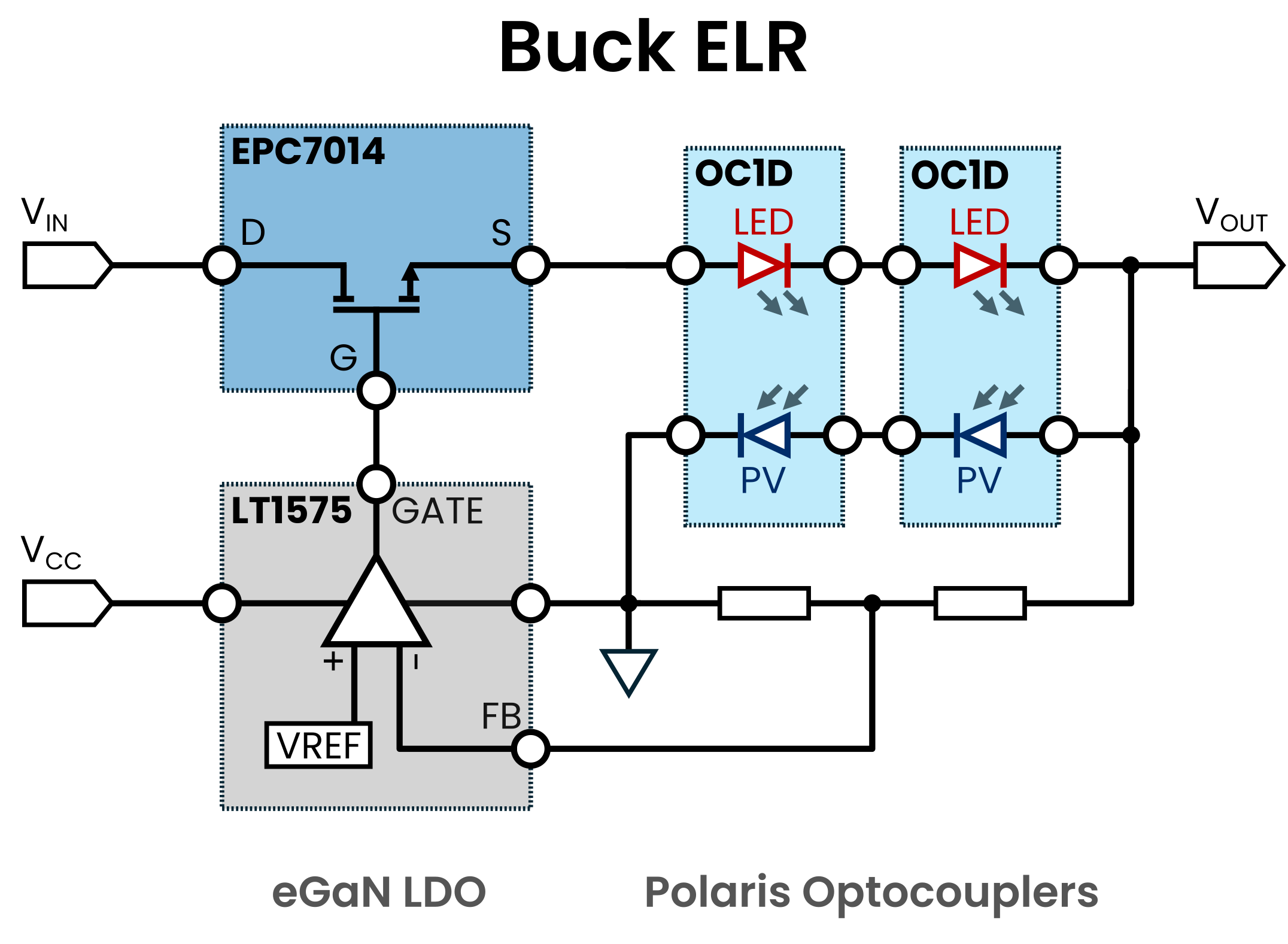
A buck regulator from two OC1D parts
Put two OC1D LEDs in series with the pass transistor of a linear regulator, and connect their photovoltaic cells to the output. Power the regulator would otherwise burn as heat goes back to the load as current.
PSAN006 wires the same two parts for step-up and inverting outputs too.
Technical documentation
Spotlights, application notes, and white papers covering OC1D.
Datasheets and SPICE models ship with a sample request — or email [email protected].
Ready to design it in?
Request evaluation samples, detailed datasheets, and SPICE models — an engineer answers, not a sales funnel.