

ALEXANDRIA, VA — September 14, 2026 — Polaris Semiconductor, Planar Monolithics (PMI) and The Ohio State University have published a technical feature article in the September 2026 issue of Microwave Journal. The article, “Efficient, Switching-Free Buck and Boost Conversion for RF Circuits,” introduces the Polaris Enhanced Linear Regulator (ELR) to the RF design community and documents its design-in to a PMI voltage-variable attenuator, where it eliminated regulator-induced artifacts and improved the attenuator’s dynamic range by more than 30 dB.
Where a switching regulator runs out of dynamic range
Voltage-variable attenuators (VVAs) provide precise signal-level control in RF systems ranging from electronic warfare to communications test equipment, and system requirements keep pushing them toward wider dynamic range in smaller, lower-power packages. At high attenuation — 60 dB and beyond — even minute power-supply artifacts can dominate the output spectrum. The ripple and harmonics of a switching regulator, however well filtered, appear as discrete spurs that rise above the attenuated signal, and what counts as negligible noise in many circuits becomes the limit on achievable dynamic range.
PMI’s attenuators had reached exactly that limit. Its switching regulator was efficient, but high-frequency harmonics were visible on the RF carrier output and capped usable dynamic range at roughly 60 dB. An all-linear supply removed the spurs entirely, but drew far more current and ran too hot for the module’s thermal budget. The conventional compromise — a switching regulator followed by a low-dropout linear post-regulator — carried a footprint the design could not accommodate, and even that approach can leave residual spurs incompatible with a 100 dB dynamic-range target.
More than 30 dB, at near-switching-level efficiency
The Polaris BK300D50E offered a way through. It is a switching-free buck ELR that co-packages Analog Devices’ LT3045 ultra-low-noise regulator with five Polaris photovoltaic-output optocouplers in a single 7 mm × 7 mm QFN package. In the attenuator it performs a regulated 12 V to 5 V step — a major thermal challenge for a conventional linear regulator where most of the input power is dissipated as heat. The optocouplers improve efficiency by recovering power that would otherwise be wasted, while the output retains the LT3045’s noise floor — below 1 µV RMS — and its power-supply ripple rejection of more than 120 dB. To the board designer, it behaves like any other linear regulator.
In the PMI attenuator, the BK300D50E eliminated the switching spurs at near-switching-level efficiency, well within the thermal budget that had ruled out a conventional linear regulator. Measured on a spectrum analyzer, the attenuator’s spur-free dynamic range improved by more than 30 dB, from roughly 60 dB to beyond 90 dB. Because the ELR follows standard linear-regulator design practice, it also removed the EMC risks that accompany a switching regulator and significantly reduced the power-management bill of materials.
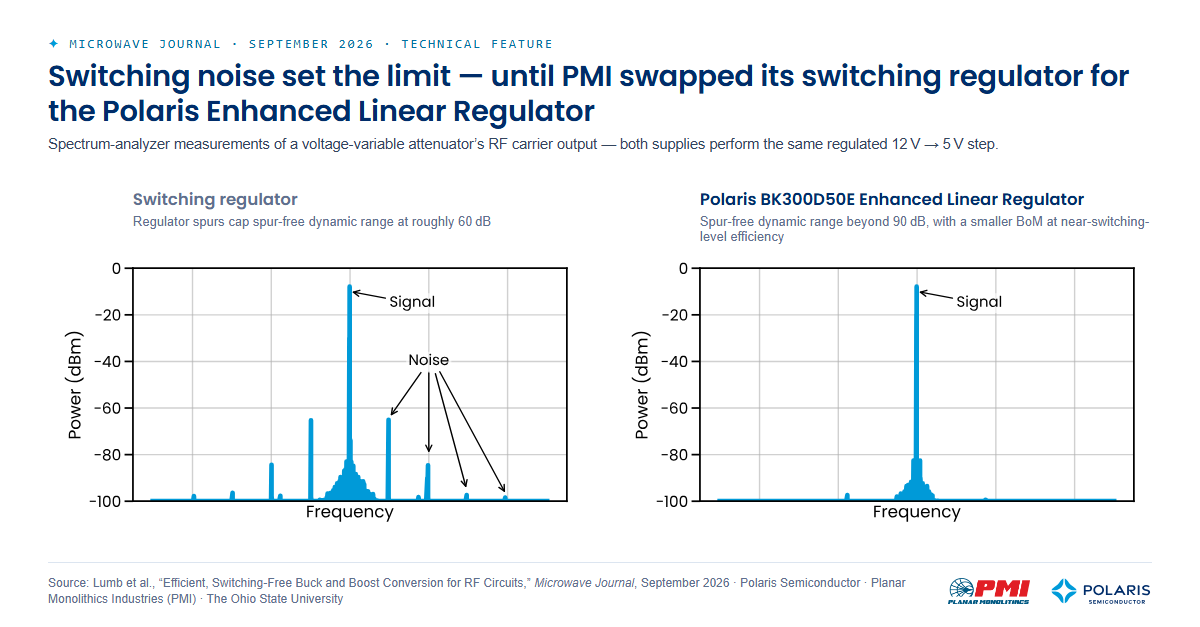
Spectrum-analyzer measurements of the attenuator’s RF carrier output with the original switching regulator (left) and the Polaris BK300D50E ELR (right), from the article’s Figure 7.
“We plan to incorporate Polaris products into more of the PMI portfolio,” said Dave Durbin, Director of Engineering and Vice President at PMI. “The advantages of Polaris technology could have wide-ranging impacts in a great number of other noise-sensitive applications.”
“PMI has built its reputation by achieving engineering excellence — driving down the size, weight, and power of RF components while pushing signal fidelity higher, which is exactly the environment where power supply performance can be a major bottleneck,” said Dr. Matthew Lumb, Co-Founder and CEO of Polaris Semiconductor. “It has been a pleasure to work with a team of that caliber, and there is no better validation of the ELR than earning its place inside a PMI attenuator.”
Read the article
The feature, “Efficient, Switching-Free Buck and Boost Conversion for RF Circuits,” is available from Microwave Journal. It covers the ELR’s operating principle; the BK300D50E’s measured input current, output noise, and ripple rejection; and the spectrum-analyzer comparison of the attenuator’s RF output under the switching regulator and the ELR. For RF component designers facing the same ceiling, it offers a measured, published reference point for what a switching-free supply does inside a PMI attenuator.
The ELR-powered attenuators are available from PMI — www.pmi-rf.com/categories/digitally-controlled-attenuators
Product details for the BK30 family, including the BK300D50E, are at www.polarissemiconductor.com/bk30.
About Polaris Semiconductor
Polaris Semiconductor designs and manufactures advanced DC voltage regulators optimized for ultra-low noise, compact integration, and high efficiency across aerospace, defense, instrumentation, and high-performance computing sectors. Based in Alexandria, VA, the company’s mission is to push the boundaries of what’s possible in analog power design.
More information: www.polarissemiconductor.com
About PMI
Planar Monolithics Industries, Inc., a leading designer & manufacturer of custom, high-reliability radio frequency microwave components and subsystems covering DC to 70 GHz. Delivering industry-standard performance for mission-critical applications in the military, communications, commercial and consumer industries. PMI has facilities in Frederick, Maryland, and El Dorado Hills, California.
More information: www.pmi-rf.com