
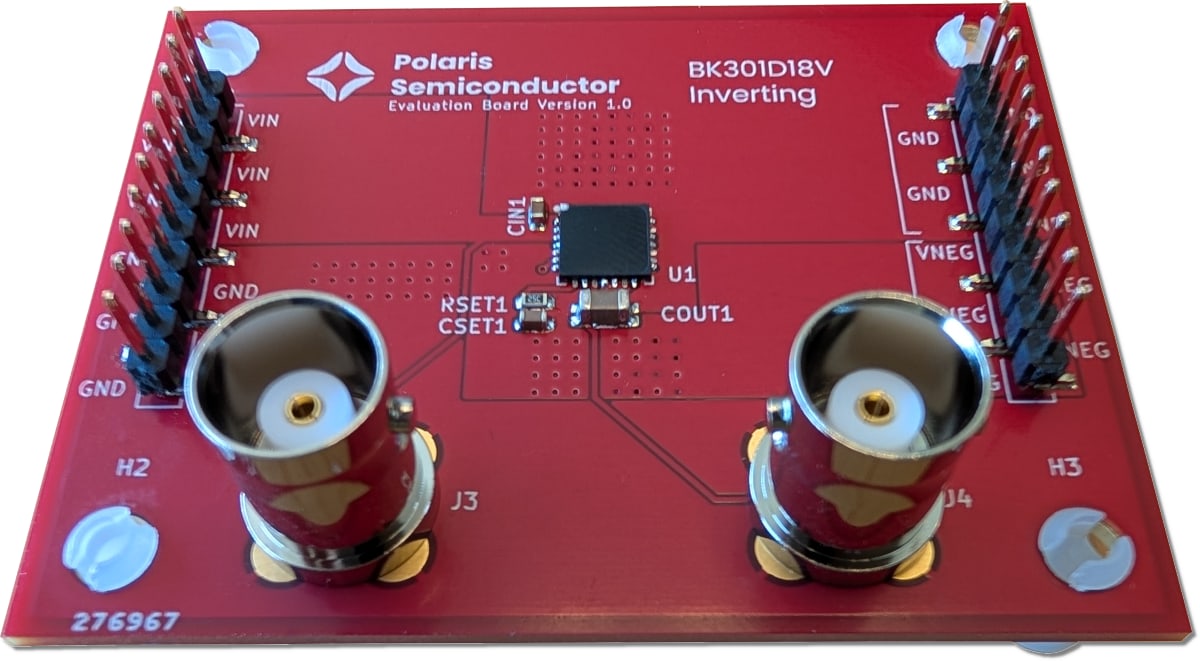
New application note, co-authored with engineers at Analog Devices, shows how to make a clean negative voltage from a positive supply without a switching converter
Alexandria, VA – October 27, 2026 – Polaris Semiconductor today published PSAN005, an application note showing how the company’s Enhanced Linear Regulator (ELR) can produce a negative voltage from an ordinary positive supply. The circuit has no switching parts and no inductor, so it avoids the electrical noise that switching circuits generate. The note was co-authored with engineers at Analog Devices (ADI).
Many electronic systems need a negative voltage alongside their positive ones. Precision sensors, the converters that translate between analog and digital signals, low-distortion amplifiers, and the circuits that control some power transistors can all need one. Many of these systems start from a positive supply only, so designers typically generate the negative rail with a switching circuit. These circuits work by turning current on and off at high speed, which creates electrical noise that can reach the sensitive electronics nearby. Containing it takes extra filtering parts and board space, and a product that fails electromagnetic-compatibility (EMC) testing can face a costly redesign.
The technique demonstrated in PSAN005 uses the Polaris Semiconductor BK301D18V. This part co-packages patented photovoltaic-output optocouplers with the Analog Devices LT3045, a linear regulator known for its very low electrical noise, in compact QFN packages. Like a transformer, the optocouplers can raise or lower voltages relative to ground, so changing how the device’s pins are connected turns this step-down regulator into an inverting one that produces a −1.8 V rail from a positive supply. The same approach can be applied to any of Polaris’ step-down ELRs, including the higher-current BK29 family.
Verifying electrical noise below one millionth of a volt calls for specialized equipment and experience, so Polaris turned to ADI, whose engineers specialize in regulators with exceptionally low electrical noise. ADI engineers Luis Sanchez and Andrew Radosevich used ADI’s in-house methods to measure the electrical noise of the BK301D18V in both its standard step-down setup and the new inverting one, independently confirming what Polaris had measured in its own lab. The ELR’s electrical noise is virtually indistinguishable from that of an LT3045 on its own, and the inverting version keeps the LT3045’s very strong ability to block disturbances arriving on its input supply. Polaris extends where that performance can be used. Changing how an ELR’s regulator and optocouplers are connected takes it from a step-down regulator that stays efficient across large step-downs in voltage to one that can raise a voltage or invert it, jobs that have traditionally required a switching converter.
For Polaris, PSAN005 opens another set of applications for the ELR. The sensors, data converters, and amplifiers that need negative rails are found throughout the markets the company serves, from spacecraft and defense electronics to scientific instruments and communications equipment. Designers in those markets can now build both their positive and negative rails from the same family of parts.
“We were glad to have Luis and Andrew at Analog Devices make these measurements, and their results match what we saw in our own lab,” said Dr. Matthew Lumb, Co-Founder and CEO of Polaris Semiconductor. “Our aim is to bring the performance of leading linear regulators to work they could not do before. A clean negative voltage from a positive supply is a good example, and one that a wide range of systems need.”
The complete application note, including measured results, schematic, PCB layout, and bill of materials, is available for download at no cost from the Polaris Semiconductor technical documentation library. Samples and evaluation boards for the BK30 and BK29 families can be requested through the sample request form.
About Polaris Semiconductor
Polaris Semiconductor designs and manufactures advanced DC voltage regulators optimized for ultra-low electrical noise, compact integration, and high efficiency across aerospace, defense, RF, precision sensing, instrumentation, and high-performance computing sectors. Based in Alexandria, VA, the company’s mission is to break through conventional limits in DC power design.
More information: www.polarissemiconductor.com