
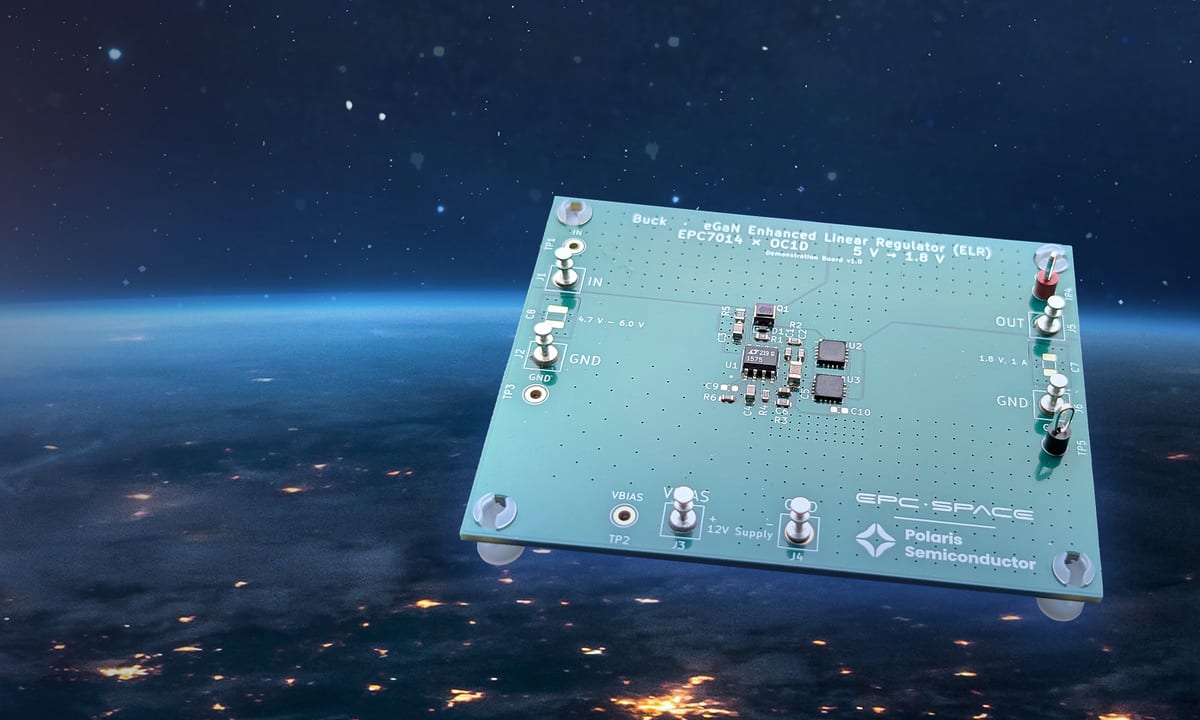
New application note, co-authored with EPC Space, expands where linear regulators can power the most sensitive electronics in space
Alexandria, VA – November 9, 2026 – Polaris Semiconductor today published PSAN006, an application note written jointly with EPC Space. Its authors are Kenneth Schmieder and Matthew Lumb of Polaris Semiconductor and Maurizio Salato and Bel Lazar of EPC Space. The note describes four demonstration boards that pair EPC Space’s radiation-hardened eGaN® power transistor with Polaris’ Enhanced Linear Regulator (ELR) technology. Built from one shared design, the boards step a voltage down, step it up, and turn a positive supply into a negative one, all without switching.
Spacecraft rely on linear regulators to power their most sensitive electronics, such as radio receivers, the clocks behind high-speed data links, and precision sensing instruments, where electrical noise from a power supply can corrupt the signal. A linear regulator creates no switching noise of its own, but two limits have held it back in space. Its main transistor has to survive radiation, which has meant using radiation-hardened silicon parts that a single heavy-ion strike can still destroy. And it turns the entire voltage it drops into heat, so it has only been practical for small steps down in voltage. Larger steps, raising a voltage, and making a negative one have been left to switching converters, along with the major design headaches their output ripple and radiated emissions create.
PSAN006 answers each limit with one partner’s technology. EPC Space’s radiation-hardened eGaN transistors address radiation, because they lack the weak points through which a single heavy-ion strike can destroy a silicon power transistor. Polaris’ ELRs address the heat. Their optocouplers turn part of the dropped voltage into light, and photovoltaic cells return that light to the output as electrical current, recovering most of the power a conventional linear regulator would waste. Connected one way, the optocouplers make a step-down regulator far more efficient; connected another, they raise the voltage or produce a negative one. Nothing switches in any of these arrangements, and the optocouplers are radiation-resilient by design.
The four boards share one controller, one EPC Space EPC7014 transistor, and one bill of materials. A conventional linear regulator serves as the baseline, and each ELR version adds two Polaris OC1D photovoltaic optocouplers and otherwise differs only in a few connections and resistor values. Doing the same job as the conventional regulator, the step-down ELR is far more efficient and runs with less than half the heat; run to the same temperature, it delivers more than three times the power. The step-up ELR raises a single lithium-ion cell to 5 V, and the inverting ELR makes a negative voltage with no inductor and no switching. In every arrangement, the electrical noise stays essentially that of the underlying regulator.
“Linear regulators have always powered the most sensitive electronics in space, but at the expense of efficiency,” said Kenneth Schmieder, Co-Founder and CTO of Polaris Semiconductor and lead author of the note. “With EPC Space’s radiation-hardened eGaN and our optocoupler enhancement, switching-free power conversion with low electrical noise is now available for large voltage drops, step-up, and negative voltages. That matters for every noise-sensitive load on a spacecraft, and we’re glad to have built it with the EPC Space team.”
“EPC Space already offers evaluation boards that use our radiation-hardened eGaN transistors in linear regulators, and this work with Polaris takes that approach much further,” said Bel Lazar, CEO of EPC Space and a co-author of the note. “Paired with Polaris’ optocouplers, an eGaN linear regulator can now take on jobs that used to call for a switching converter, without the electrical noise that comes with one. We look forward to seeing spacecraft power designers try these designs for themselves.”
The demonstration boards use discrete parts, and the note describes how co-packaging the same elements shrinks the footprint well below that of switching alternatives. Demonstration boards are planned for availability through Polaris Semiconductor, and custom configurations and co-packaging are supported jointly by EPC Space and Polaris Semiconductor. The complete application note, including measured results, schematics, circuit-board layouts, and a bill of materials for all four boards, is available for download at no cost from the Polaris Semiconductor technical documentation library.
About Polaris Semiconductor
Polaris Semiconductor designs and manufactures advanced DC voltage regulators optimized for ultra-low electrical noise, compact integration, and high efficiency across aerospace, defense, RF, precision sensing, instrumentation, and high-performance computing sectors. Based in Alexandria, VA, the company’s mission is to break through conventional limits in DC power design.
More information: www.polarissemiconductor.com
About EPC Space
EPC Space provides revolutionary high-reliability radiation-hardened enhancement-mode gallium nitride power management solutions for space and other harsh environments. Radiation hardened GaN-based power devices address critical spaceborne environments for applications such as power supplies, motor drives, ion thrusters, and more.
eGaN is a registered trademark of Efficient Power Conversion Corporation, Inc.
More information: epc.space